The Scaffolding and Conquest Method: A Universal Framework for Systematic Innovation at Scale

Abstract
This paper presents the Scaffolding and Conquest Method, a systematic approach to solving complex, well-defined problems through the strategic separation of tractable infrastructure development from intractable core challenges. The methodology consists of four distinct phases: Definition & Decomposition (Phase 0), Foundational Scaffolding (Phase 1), Focused Conquest (Phase 2), and Synthesis & Final Systematization (Phase 3), with iterative feedback loops between phases. Through extensive analysis across multiple industries—including technology, healthcare, finance, manufacturing, retail, entertainment, and food service—we demonstrate that this framework represents a universal pattern for innovation-driven organizations operating at scale. The method synthesizes established principles from systems engineering, platform strategy, and R&D management into a unified framework. The core principle is the systematic conversion of known engineering challenges into robust infrastructure (Scaffolding), which then enables focused, specialized assault on the core intractable problems (Conquest). We argue that this approach represents the actual operational pattern of successful, large-scale organizations across diverse sectors, while acknowledging its limitations for smaller organizations and exploratory research contexts.
1. Introduction
The challenge of systematic innovation at scale has long been a central concern for organizations seeking to maintain competitive advantage in rapidly evolving markets. Traditional approaches to complex problem-solving often fail to distinguish between different types of challenges, leading to inefficient resource allocation and suboptimal outcomes. This paper introduces the Scaffolding and Conquest Method, a framework that addresses this fundamental issue by providing a structured approach to separating tractable infrastructure problems from intractable core challenges.
The methodology emerges from the observation that successful large-scale organizations across diverse industries share a common pattern: they systematically build robust infrastructure to handle the "known" aspects of their operations, allowing their most valuable resources to focus exclusively on the "unknown" challenges that represent true innovation. This pattern, while often implicit in successful organizations, has not been formally articulated as a systematic methodology.
1.1 Theoretical Context and Literature Synthesis
The Scaffolding and Conquest Method synthesizes established principles from multiple domains:
Systems Engineering: The decomposition of complex systems into subsystems, with known engineering constraints addressed before novel components, is foundational to systems engineering (INCOSE, 2015). The method extends this principle to organizational strategy.
Platform Strategy: The concept of building stable, reusable platforms that enable ecosystems of applications is central to business strategy (Gawer & Cusumano, 2002). The "scaffold" serves as the platform for "conquest" activities.
R&D Management: The separation of foundational research from applied development is a classic R&D management paradigm (Tidd & Bessant, 2018). The method formalizes this separation at the organizational level.
DevOps and "Paved Path" Concepts: The "Paved Path" concept, popularized by companies like Netflix and Spotify, represents the infrastructure-first approach to developer productivity (Humble & Farley, 2010).
This paper's primary contribution is the codification of these disparate practices into a single, unified framework with a clear lexicon (Scaffolding, Conquest, Meta-Solver), a phased implementation model, and a set of diagnostic anti-patterns, thereby making an implicit best practice an explicit and transferable methodology.
2. Theoretical Foundation
2.1 Core Principles
The Scaffolding and Conquest Method is built on three fundamental principles:
- Separation of Concerns: Complex problems can be decomposed into two distinct categories: tractable problems (with known solutions) and intractable problems (requiring novel solutions).
- Infrastructure First: Tractable problems should be solved systematically and converted into reusable infrastructure before attempting to solve intractable problems.
- Focused Innovation: Once infrastructure is in place, organizations can focus their most valuable resources exclusively on the intractable core challenges.
2.2 The Four-Phase Framework with Iterative Loops
The methodology consists of four distinct phases, each with specific objectives and outcomes, connected by iterative feedback loops:
Phase 0: Definition & Decomposition
This strategic phase involves:
- Goal Articulation: Defining specific, measurable objectives with clear success metrics
- Problem Inventory: Decomposing the overall goal into sub-problems and categorizing them as either tractable, intractable, or "gray zone"
- Phase 0 Council Assembly: Cross-functional team including Visionary, System Architect, Pioneer, Operator, and Skeptic roles
- Methodological Toolkit: Time-and-money heuristic, first-principles decomposition, state-of-the-art boundary mapping, constraint analysis
Phase 1: Foundational Scaffolding
This phase focuses on:
- Infrastructure Development: Building permanent, reusable solutions for tractable problems
- Clearing the "War Fog": Reducing uncertainty and creating predictable development environments
- Isolation of Core Problems: Creating a "laboratory" where the hard problems can be addressed
- Iterative Feedback: Continuous refinement based on Conquest team discoveries
Phase 2: Focused Conquest
This phase involves:
- Problem Reshaping: Breaking down intractable problems into specialized sub-cases
- Specialized Teams: Assigning dedicated teams to specific aspects of the core challenge
- Rapid Iteration: Using the scaffold to test and refine solutions quickly
- Scaffold Evolution: Discoveries often require scaffold modifications, creating feedback loops to Phase 1
Phase 3: Synthesis & Final Systematization
This final phase includes:
- Meta-Solver Development: Creating systems to intelligently compose solutions from specialized teams
- Infrastructure Integration: Converting the entire solution into hardened, repeatable infrastructure
- Completion of the Loop: Creating a "factory" for producing similar solutions in the future
2.3 Iterative Nature and Dynamic Boundaries
The framework acknowledges that the boundary between tractable and intractable problems is dynamic and context-dependent. Problems may shift categories as:
- Scale requirements change
- New technologies emerge
- Breakthroughs in Conquest phase make new Scaffolding problems tractable
- Market conditions evolve
The iterative feedback loops between phases ensure the framework remains adaptive to these changes.
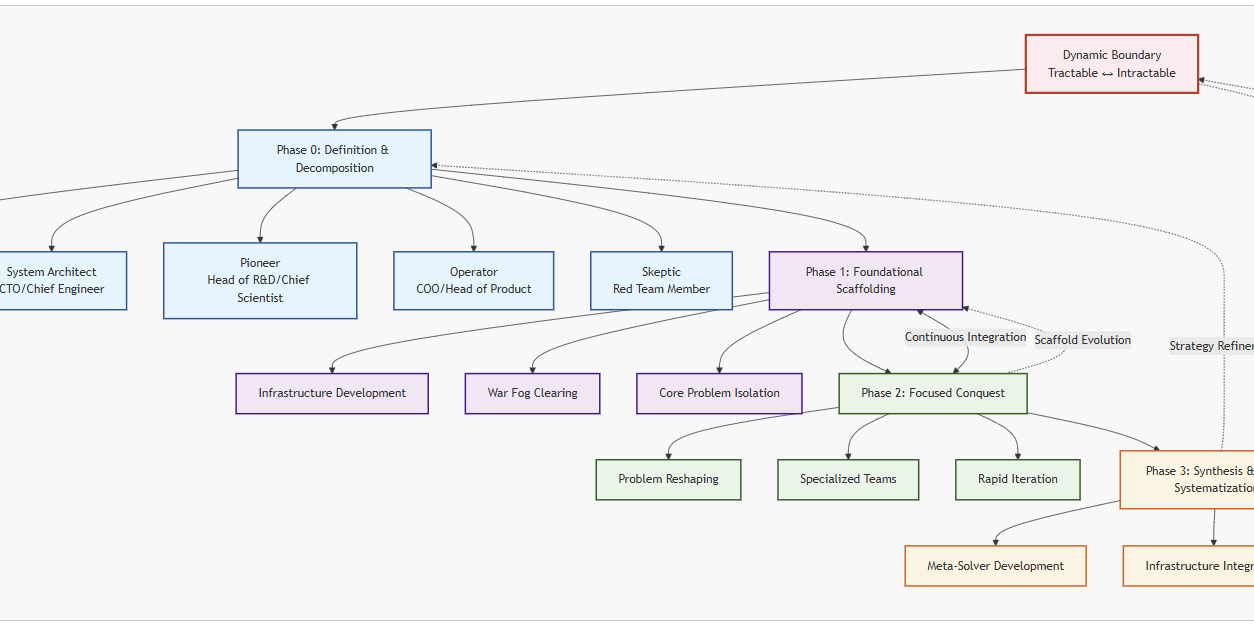
2.4 Visual Framework Representation
Scaffold EvolutionStrategy RefinementContinuous IntegrationMarket EvolutionDynamic BoundaryTractable ↔ IntractablePhase 0: Definition & DecompositionVisionaryCEO/GM/Strategic LeadSystem ArchitectCTO/Chief EngineerPioneerHead of R&D/Chief ScientistOperatorCOO/Head of ProductSkepticRed Team MemberPhase 1: Foundational ScaffoldingInfrastructure DevelopmentWar Fog ClearingCore Problem IsolationPhase 2: Focused ConquestProblem ReshapingSpecialized TeamsRapid IterationPhase 3: Synthesis & Final SystematizationMeta-Solver DevelopmentInfrastructure IntegrationInnovation Factory
This diagram illustrates the four-phase framework with iterative feedback loops and the dynamic boundary between tractable and intractable problems that shifts over time.
3. Industry Applications
3.1 Technology Sector
Autonomous Vehicles
Goal: Develop Level 4 autonomous driving systems for urban environments.
Phase 0: Achieve disengagement rate < 1 per 10,000 miles with zero at-fault accidents.
Tractable Problems: Physical car platforms, data infrastructure, simulation environments, CI/CD pipelines, basic vehicle controls.
Intractable Problem: Core decision-making software for perception and navigation.
Scaffolding: World-class data and simulation engine with realistic virtual testing environments.
Conquest Teams:
- Team A (Perception): Object identification and classification
- Team B (Prediction): Behavior prediction for all actors
- Team C (Planning): Path determination and edge case handling
Meta-Solver: Main Control Loop software that composes inputs from specialized modules.
Software Development (Google, Meta, Netflix)
Scaffolding Examples:
- Google: Monorepo with Blaze/Bazel build system
- Meta: Developer infrastructure with Buck, Tupperware, and A/B testing frameworks
- Netflix: "Paved Path" developer platform
3.2 Healthcare Sector
Drug Discovery
Goal: Discover novel, effective small-molecule drugs for specific cancer types.
Phase 0: Identify lead compounds with 50% tumor reduction and acceptable toxicity profiles.
Tractable Problems: Lab automation, data platforms, computational chemistry platforms, clinical trial management.
Intractable Problem: Identifying novel biological targets and designing effective, safe molecules.
Scaffolding: Computational discovery platform with automated labs and integrated data streams.
Conquest Teams:
- Team A (Target ID & Validation): Genomics and systems biology
- Team B (Computational Design): AI/ML molecule design
- Team C (Assay & Screening): Biological testing and HTS
Meta-Solver: Lead Candidate Selection Committee with integrated dashboard for compound evaluation.
3.3 Finance Sector
Quantitative Trading
Goal: Build successful, market-neutral, multi-strategy quantitative hedge funds.
Phase 0: Achieve 15% annual return with Sharpe ratio > 2.0 and maximum drawdown < 10%.
Tractable Problems: Data infrastructure, backtesting engines, execution infrastructure, risk management tools.
Intractable Problem: Discovering novel predictive signals ("alpha") not already arbitraged away.
Scaffolding: State-of-the-art quant research platform enabling rapid strategy development and testing.
Conquest Teams:
- Team A (Equities Stat-Arb): Short-term price reversions and statistical relationships
- Team B (Futures Macro): Macroeconomic trends and events
- Team C (NLP/Alternative Data): Alternative data sources and sentiment analysis
Meta-Solver: Portfolio Construction Optimizer that allocates capital across signals based on expected returns, risks, and correlations.
3.4 Manufacturing Sector
Aerospace Design
Goal: Design next-generation, fuel-efficient commercial aircraft wings.
Phase 0: Achieve 15% fuel efficiency improvement and 20% weight reduction while meeting FAA requirements.
Tractable Problems: CAD software, CFD/FEA simulation farms, project management, materials databases.
Intractable Problem: Novel aerodynamic shapes and composite structures meeting aggressive targets.
Scaffolding: Digital twin design and simulation environment with automated analysis pipelines.
Conquest Teams:
- Team A (Aerodynamics): External shape optimization for drag reduction
- Team B (Structural Engineering): Internal composite structure for strength and weight
- Team C (Manufacturing): Design manufacturability and cost analysis
Meta-Solver: Multi-Disciplinary Optimization (MDO) software for global design optimization.
3.5 Retail Sector
Fast Fashion (Zara)
Goal: Consistently capture fashion trends and convert them into profitable clothing lines.
Phase 0: Reduce concept-to-store cycle to under 4 weeks for 50% of items with 55%+ gross margin.
Tractable Problems: Logistics, manufacturing, POS systems, inventory management, store layouts.
Intractable Problem: Predicting consumer preferences and designing appealing garments.
Scaffolding: Sophisticated fast fashion supply chain with centralized design hub, agile manufacturing, and real-time sales feedback.
Conquest Teams:
- Team A (Trend Spotters): Fashion show and social media trend identification
- Team B (Designers): Rapid sketch and pattern creation
- Team C (Prototypers): Sample creation using manufacturing network
Meta-Solver: Commercial Directors who evaluate designs against sales data and make production decisions.
3.6 Entertainment Sector
Film Production (Marvel Studios/Pixar)
Goal: Reliably produce blockbuster films that are both critically acclaimed and commercially successful.
Phase 0: Produce two films annually grossing $750M+ with 85%+ Rotten Tomatoes scores.
Tractable Problems: 3D rendering pipelines, project management, sound mixing, VFX workflows, casting databases.
Intractable Problem: Creating timeless stories with emotionally resonant characters.
Scaffolding:
- Pixar: Proprietary animation pipeline (Presto) and Brain Trust feedback system
- Marvel: Marvel Cinematic Universe (MCU) as narrative scaffold
Conquest Teams: Dedicated story teams for individual films using scaffold for feedback and context.
Meta-Solver: Directors and studio executives (e.g., Kevin Feige) who synthesize story with technical departments.
3.7 Food Service Sector
Quick Service Restaurants (McDonald's)
Goal: Develop and deploy globally popular menu items.
Phase 0: Launch products producible across 30,000+ locations meeting cost targets and sales goals.
Tractable Problems: Global supply chain, franchisee training, real estate, kitchen equipment, POS systems.
Intractable Problem: Inventing delicious, novel, inexpensive items preparable by minimally trained staff.
Scaffolding: Complete franchise system including Speedee Service System, Hamburger University, and global supply chain.
Conquest Teams: Innovation Center R&D chefs focusing on taste, texture, and repeatable processes.
Meta-Solver: Menu Management Board evaluating products against supply chain, manufacturing, and training constraints.
4. Universal Patterns and Principles
4.1 Why the Method is Universal
The Scaffolding and Conquest Method appears universal because most innovation projects consist of two distinct types of work:
- Known Engineering: Complex problems with known solutions requiring significant resources
- Unknown R&D: Core creative or scientific leaps representing true innovation
4.2 The Meta-Solver: Resource Allocation and Synthesis
The Meta-Solver represents the critical synthesis mechanism that intelligently combines outputs from specialized Conquest teams into coherent solutions. Drawing from established frameworks across multiple domains, the Meta-Solver operates as a sophisticated resource allocation and integration system.
Model Ensembling in Machine Learning: The Meta-Solver functions similarly to ensemble methods in machine learning, where multiple specialized models (Conquest teams) are combined to produce more robust predictions than any single model. The Meta-Solver must determine optimal weights for each team's contribution based on their performance, reliability, and domain expertise.
Portfolio Theory and Capital Allocation: Following Ray Dalio's "Holy Grail" investment strategy, the Meta-Solver seeks low-correlation, high-return combinations of Conquest team outputs. It allocates resources and attention based on risk-adjusted returns, diversification benefits, and correlation analysis between different approaches.
Venture Capital Fund Strategy: Like successful VC funds, the Meta-Solver must balance portfolio construction across high-risk/high-reward Conquest bets and more predictable Scaffolding investments. It performs due diligence on Conquest team proposals, monitors progress, and makes go/no-go decisions on resource allocation.
Key Meta-Solver Functions:
- Synthesis: Intelligently combining outputs from multiple Conquest teams
- Conflict Resolution: Managing disagreements between specialized teams
- Resource Allocation: Optimizing capital, talent, and infrastructure across teams
- Risk Management: Balancing high-risk Conquest bets with stable Scaffolding returns
- Integration: Ensuring Conquest solutions work seamlessly with Scaffolding infrastructure
- Performance Monitoring: Tracking team effectiveness and adjusting allocations accordingly
The Meta-Solver is not a single entity but the organization's synthesis function. This function can be embodied in a specific individual (e.g., a visionary product leader like Marvel's Kevin Feige), a formal committee (e.g., a quant fund's Investment Committee), a defined process (e.g., Pixar's 'Brain Trust'), or increasingly, in sophisticated software systems (e.g., an MDO platform in aerospace). The embodiment depends on the organization's size, complexity, and technological sophistication, but the core function remains consistent: intelligent synthesis of specialized outputs into coherent solutions.
4.3 Key Success Factors
De-risking: Systematic de-risking of massive projects by solving solvable problems first Focus: Allowing valuable talent to focus exclusively on hard problems Scalability: Converting innovation from one-off projects into repeatable processes Parallelization: Natural parallelization of work on hardest problem components Meta-Solver Effectiveness: Sophisticated resource allocation and synthesis capabilities
4.4 Organizational Context and Scalability
The Scaffolding and Conquest Method is primarily designed for systematic innovation at scale. The framework adapts to different organizational contexts:
Large Organizations (Google, Amazon, Tesla): Can build extensive, permanent scaffolding with dedicated platform teams and massive infrastructure investments.
Mid-Size Organizations: May use cloud services, open-source tools, and third-party platforms as their "scaffold," focusing on building domain-specific infrastructure.
Startups and Small Teams: The principle remains valid but implementation differs radically. A startup's "scaffold" might be simple tools and cloud services, while the "conquest" focuses on the core value proposition. The Lean Startup methodology represents a resource-constrained version of this principle.
Resource-Constrained Contexts: The method acknowledges that scaffold and conquest are often built concurrently in a messier, iterative process when resources are limited.
4.4.1 Cultural Prerequisites for Success
The Scaffolding and Conquest Method requires specific cultural foundations to function effectively:
Long-Term Vision: The method requires an organizational culture that rewards long-term infrastructure investment, which often conflicts with short-term, feature-focused incentive structures. Organizations must be willing to invest in scaffolding that may not show immediate returns but enables future conquest success.
Psychological Safety: The "Skeptic" role in the Phase 0 Council can only function in a culture of high psychological safety where challenging core assumptions is encouraged, not punished. Teams must feel safe to question fundamental premises and admit when problems are more complex than initially thought.
Inter-Team Collaboration: The feedback loops between Scaffolding and Conquest teams require a collaborative, non-siloed culture to function effectively. Teams must be willing to share discoveries, adapt their approaches based on others' findings, and work together toward the common goal rather than protecting their own domains.
4.5 Limitations
The method has significant limitations in certain contexts:
Pure Blue-Sky Research: Requires well-defined problems. The method is poorly suited for exploratory research, serendipitous discovery, or fundamental scientific research without clear applications.
Disruptive Innovation: Not suitable for responding to sudden, paradigm-shifting market changes or disruptive innovations that require rapid pivoting.
Small-Scale Projects: May be overkill for small teams or simple problems that don't require systematic infrastructure.
Deeply Intertwined Problems: Some problems cannot be meaningfully separated into scaffold and core challenges, particularly in domains where the infrastructure and the innovation are fundamentally co-dependent.
Uncertain Problem Definition: The method requires clear, well-defined goals. It cannot handle problems where the goal itself is unclear or rapidly evolving.
Resource Constraints: The method assumes sufficient resources to build meaningful scaffolding, which may not be available to smaller organizations or in resource-constrained environments.
Cultural and Organizational Barriers: Requires organizational commitment to long-term infrastructure investment and may face resistance in cultures focused on short-term results.
4.6 Anti-Patterns and Common Failure Modes
While the Scaffolding and Conquest Method provides a framework for success, organizations often fall into predictable failure patterns:
The Premature Conquest: Attempting to solve intractable problems without adequate scaffolding leads to burnout, brittle one-off solutions, and repeated failures. Teams become overwhelmed by infrastructure challenges while trying to innovate.
The Endless Scaffolding: Platform teams fall in love with building infrastructure and lose sight of the Conquest goal, leading to over-engineering, gold-plating, and analysis paralysis. The scaffold becomes an end in itself rather than a means to enable conquest.
The Phase 0 Misclassification: The most critical failure occurs when a truly intractable problem is mislabeled as tractable (or vice-versa), dooming the entire project by building the wrong foundation or misallocating R&D talent. This often results from insufficient domain expertise in the Phase 0 council.
The Siloed Conquest: Conquest teams become so specialized and isolated that they cannot be synthesized effectively. The Meta-Solver fails because teams develop incompatible approaches, technologies, or outputs that cannot be integrated.
The Static Framework: Organizations treat the framework as a one-time implementation rather than an iterative process. They fail to adapt as boundaries shift, new technologies emerge, or market conditions change.
The Resource Misallocation: Meta-Solvers that lack sophisticated resource allocation capabilities may over-invest in low-return scaffolding or under-invest in high-potential conquest opportunities, leading to suboptimal outcomes.
5. The Scaffold as the Moat: Strategic Implications
Note: While these organizations may not have used this specific terminology, their operational structures and success patterns map cleanly onto the Scaffolding and Conquest framework. These are retrospective analyses that reveal the underlying patterns of successful large-scale innovation.
5.1 The "Machine that Builds the Machine" Principle
The most successful organizations recognize that the scaffold itself becomes the competitive moat. This represents a fundamental shift from product-focused to platform-focused strategy:
Google's Strategic Moat: While Google's search algorithm is valuable, their true competitive advantage lies in their global data center infrastructure and software platform that enables rapid development of new services like Maps, Gmail, and YouTube.
Amazon's Strategic Moat: Amazon's retail success is built on AWS and their logistics network—the scaffolding that enables not just retail but an entire ecosystem of services.
Tesla's Strategic Moat: Tesla's competitive advantage isn't just their battery technology but their Gigafactories and data collection/AI training infrastructure that creates a self-reinforcing loop of improvement.
5.2 Phase 0 Vision as the Ultimate Differentiator
The critical insight is that Phase 0 vision—the ability to correctly identify which problems are tractable vs. intractable and foresee how that boundary will shift—determines long-term success. This requires:
Non-Obvious Abstraction: The ability to step back from immediate product challenges and recognize that the real competitive advantage lies in building the infrastructure that enables rapid innovation.
Prediction of Future Bottlenecks: Anticipating which problems will become tractable with new technologies and which will remain intractable, allowing for strategic infrastructure investment.
Investment in Force Multipliers: The discipline to invest in scaffolding that may not show immediate returns but creates exponential advantages over time, rather than just applying more resources to immediate problems.
5.3 The Strategic Implications
Organizations that master the Scaffolding and Conquest Method don't just solve problems—they build "innovation factories" that systematically convert complex challenges into competitive advantages. The scaffold becomes the moat not through secrecy but through the massive investment and expertise required to replicate it.
6. Implementation Guidelines
6.1 Phase 0: Definition & Decomposition - The Strategic Core
Phase 0 is not merely a preliminary step but the strategic act upon which the entire enterprise succeeds or fails. This phase requires corporate prophecy—the ability to accurately see the line between known and unknown problems and foresee how that line will shift.
6.1.1 Assembling the Phase 0 Council
Phase 0 cannot be delegated or performed in isolation. It requires a dedicated, cross-functional council:
- The Visionary (CEO/GM/Strategic Lead): Articulates the ultimate business goal and holds the non-negotiable definition of success
- The System Architect (CTO/Chief Engineer): Represents the "art of the possible" with current technology and champions the Scaffolding cause
- The Pioneer (Head of R&D/Chief Scientist): Represents the frontier of knowledge and identifies fundamental breakthroughs needed for Conquest
- The Operator (COO/Head of Product): Represents constraints of reality (budget, timeline, scalability) and prevents over-engineering
- The Skeptic (Red Team member): Challenges every classification and asks critical questions about scale and assumptions
6.1.2 Methodological Toolkit for Classification
The "Time and Money" Heuristic: For any sub-problem, ask: "If I gave a world-class team a blank check and 2-3 years, could they solve this using established principles, or would they require a fundamental, unpredictable breakthrough?"
First-Principles Decomposition: Break down goals by physical or logical necessity, not organizational function. For autonomous vehicles: "What information must the system acquire? How must it process it? What decisions must it make?"
State-of-the-Art Boundary Mapping: Map the absolute edge of public and academic knowledge to define the starting line for "tractable."
Constraint and Dependency Analysis: Map dependencies between problems. If Problem X depends on intractable Problem Y, then X cannot be fully scaffolded yet.
6.1.3 Addressing the "Blurry Boundary"
Gray Zone Register: Acknowledge that binary classification is oversimplified. Create a third category for problems that seem tractable but may become intractable at scale, or vice-versa.
Boundary Prototyping and Spikes: For Gray Zone problems, charter time-boxed teams to classify rather than solve. If they succeed easily, confirm as Scaffolding; if they hit fundamental walls, reclassify as Conquest.
Second-Order Prediction: Ask "If our Conquest teams are successful, what new problems will their solution create for our infrastructure?" Design scaffolds to be modular and adaptable.
6.1.4 Phase 0 Deliverables
- Goal Articulation Document: Single, clear page defining measurable, non-negotiable objectives
- Problem Taxonomy Map: Visual diagram showing full decomposition with nodes colored as Scaffold, Conquest, or Gray Zone
- Scaffolding Charter: Detailed document specifying capabilities, APIs, and SLAs for infrastructure
- Conquest Briefs: Focused briefs for each intractable problem defining attack areas and breakthrough metrics
- Assumption Register: List of key assumptions reviewed quarterly, as changes can invalidate the entire strategy
Critical Success Factors:
- Extreme clarity in goal articulation
- Specific, measurable objectives
- Comprehensive problem inventory
- Accurate categorization with acknowledgment of gray zones
- Evidence-based classification through prototyping
Common Pitfalls:
- Vague or unmeasurable goals
- Misclassification of problem types
- Insufficient decomposition
- Ignoring gray zones and dynamic boundaries
- Lack of evidence-based classification
6.2 Phase 1: Foundational Scaffolding
Critical Success Factors:
- Permanent, reusable infrastructure solutions
- Complete automation of tractable problems
- Creation of predictable development environments
- Elimination of "war fog"
Common Pitfalls:
- One-off solutions instead of infrastructure
- Incomplete automation
- Premature focus on hard problems
6.3 Phase 2: Focused Conquest
Critical Success Factors:
- Proper problem reshaping and specialization
- Dedicated teams with deep expertise
- Rapid iteration capabilities
- Effective use of scaffold
Common Pitfalls:
- Insufficient problem decomposition
- Lack of team specialization
- Slow iteration cycles
6.4 Phase 3: Synthesis & Final Systematization
Critical Success Factors:
- Intelligent meta-solver development
- Complete infrastructure integration
- Creation of repeatable processes
- Establishment of "innovation factory"
Common Pitfalls:
- Manual integration processes
- Incomplete systematization
- Failure to create repeatable processes
7. Conclusion
The Scaffolding and Conquest Method represents a synthesis and universalization of established principles from systems engineering, platform strategy, and R&D management into a unified framework for systematic innovation at scale. The method's power lies in its systematic separation of tractable infrastructure problems from intractable core challenges, enabling organizations to build robust foundations that support focused innovation efforts.
The evidence from technology, healthcare, finance, manufacturing, retail, entertainment, and food service sectors demonstrates that this pattern represents the actual operational approach of successful, large-scale organizations. The method's applicability stems from the fundamental principle that most innovation projects at scale consist of known engineering challenges and unknown R&D problems.
The critical insight is that Phase 0 vision—the ability to correctly identify and separate these problem types through evidence-based classification—determines long-term success. Organizations that master this vision and systematically build scaffolding for tractable problems while focusing their best resources on intractable challenges create sustainable competitive advantages and scalable innovation capabilities.
However, the framework acknowledges its limitations: it is designed for systematic innovation on well-defined problems at scale, not for exploratory research, disruptive innovation, or resource-constrained contexts. The method's iterative nature and dynamic boundary recognition address the oversimplification critique while maintaining its core value proposition.
The Scaffolding and Conquest Method provides a blueprint for building the future through systematic innovation, transforming complex problem-solving from ad-hoc hero projects into repeatable, industrial processes. For large organizations seeking to solve complex, well-defined problems, this framework offers an exceptionally robust approach to organizing resources, managing risk, and systematizing breakthrough innovation.
7.1 Future Research Directions
Future research should explore:
- Quantitative metrics for measuring scaffold effectiveness
- Case studies of framework implementation in mid-size organizations
- Integration with agile and lean methodologies for smaller teams
- Empirical validation of the Phase 0 classification methodologies
- Cross-cultural applications and organizational change management requirements
References
Gawer, A., & Cusumano, M. A. (2002). Platform leadership: How Intel, Microsoft, and Cisco drive industry innovation. Harvard Business School Press.
Humble, J., & Farley, D. (2010). Continuous delivery: Reliable software releases through build, test, and deployment automation. Addison-Wesley Professional.
INCOSE. (2015). Systems engineering handbook: A guide for system life cycle processes and activities. John Wiley & Sons.
Tidd, J., & Bessant, J. (2018). Managing innovation: Integrating technological, market and organizational change. John Wiley & Sons.
Note: This paper is based on extensive analysis of successful organizations across multiple industries. While specific company examples are drawn from publicly available information, the framework represents a synthesis of observed patterns rather than proprietary insights.
Keywords: Innovation, Problem-solving, Infrastructure, Systematic Innovation, Organizational Strategy, Competitive Advantage, Resource Allocation, Risk Management